

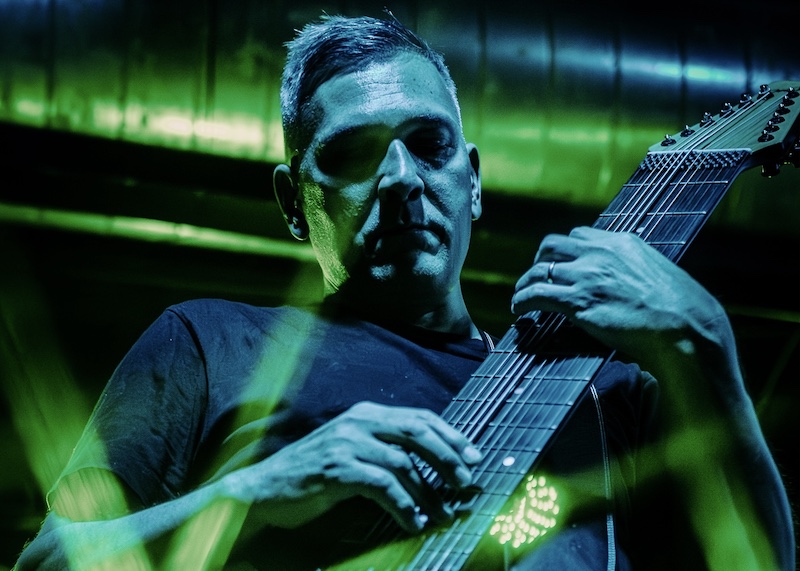
Chicago’s Jason Blake is in a constant state of motion. One of the most prolific Warr guitar masters, when he’s not performing and recording in the progressive metal band Aziola Cry, he explores creativity as a solo artist. With over a dozen titles under his namesake, Blake experiments with the art of creativity and discovery within his music while breaking free of boundaries.
With his latest seven-song EP, Infinite Fade, Blake explores a dystopian vision of an imminent society and its downfall. Void of vocals, his guitar work paints the story occasionally bringing Aziola Cry bandmate and drummer Tommy Murray into the story.
Blake talks about the new album, how Chicago is an influence, and his creative approach to music.
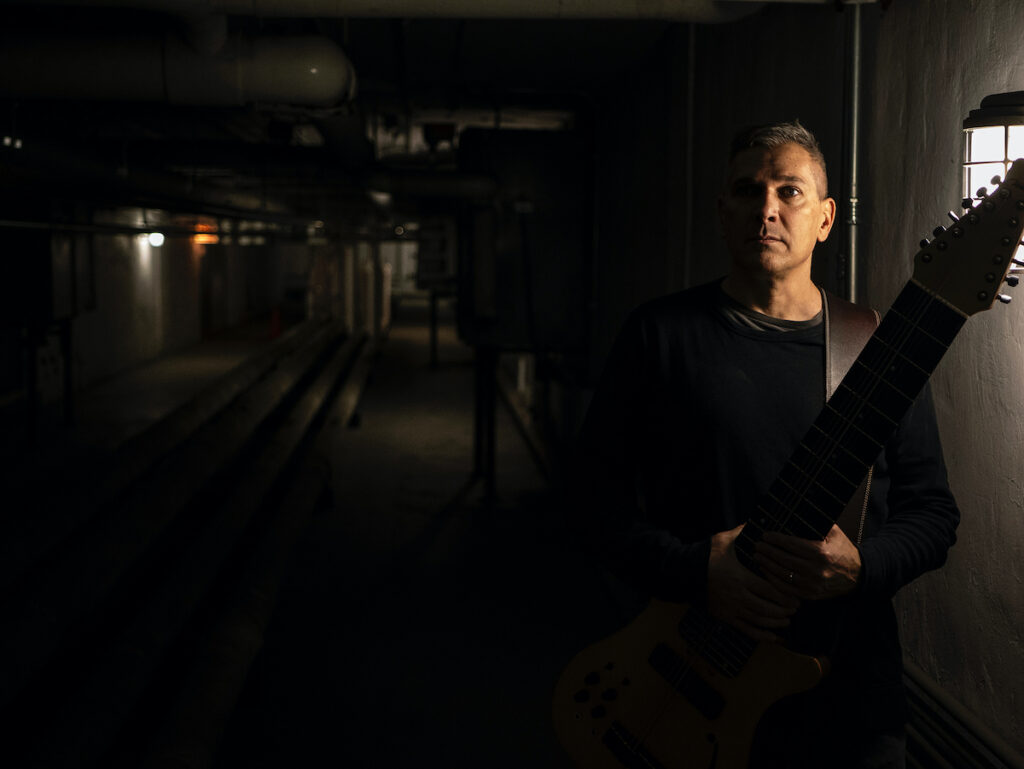
What was the feeling like when you discovered the Warr guitar and what inspired you to devote time and passion into mastering it?
To be honest, my initial thought after getting my first Warr Guitar was “What have I got myself into?!?” It was not a simple transition from bass and required a lot of attention. I think that is what ultimately drove me to focus on the instrument exclusively. I found it to be a challenge with no real set of rules. Most of my development was based on what I personally wanted from the instrument and the journey of slowly trying to get there.
How did Chicago shape you as a musician?
I used to put myself out there a lot by playing with as many people as possible from the scene. This was helpful in my growth by playing a lot and in many different settings. I would scour the music section ads of the Reader, our local free newspaper, for interesting music opportunities. Some people didn’t understand the instrument and wanted something more traditional, but there were others that liked its uniqueness. I met a lot of great musicians as a result of this process.
What led you to form Aziola Cry and how does its progressive metal elements shape your overall work as you have had great success with each release?
The music that I was writing was becoming more and more complicated, dark, and heavy. It no longer fit with the project that I was playing with at the time so it seemed right to create a band designed specifically to play this music. The band has a specific sound now so as I write new music, it goes through a filter of sorts as to if it fits the band or something else. Our latest album is complete and just awaiting its release.
Your solo work feels like the act of drifting where you can open up and stretch your creative boundaries, pouring a unique mastery of each album. How do you challenge yourself and what leads to a decision to create your solo efforts?
When something doesn’t fit the “Aziola Cry sound,” I move it to a potential solo idea. I’d say the biggest difference for me is that my solo work is typically more about the instrument and its possibilities. With the band, I am a part of the whole, whereas with my solo work, the song entirely revolves around Warr Guitar. Another way of looking at it is with the band, I see myself more as the bass player and for my solo work as a guitarist. For that reason, I try to push myself to compose interesting music that can be played without the need for other musicians as many of my gigs are solo performances.
Add to the details that you have worked with a variety of musicians to help make your visions a reality. What have you taken from these collaborations with progressive rock, ambient, and classical?
It kind of comes back to that early exploration with many different musicians from the Chicago scene. I enjoy putting the instrument into different settings. Each of the musicians that I have collaborated with bring such a uniqueness to the music and help elevate my playing.
When I think of instrumental music in Chicago, my mind goes to the post-rock scene of the late 1990s. How has genre-bending in your solo work helped break free of being stuck in a moment of time?
Yeah, I was a fan of that music. I think that comes from the idea to explore the many different possibilities of the instrument. That plus my interests as a listener of music lie in many different genres. Although my albums tend to jump around in genres, they all are an evolution for me. Sometimes they simply capture a moment in time for and other times they are a step in a progression towards something greater. At least that’s how I see it.
With all of your work, are you diligent in your research and put in careful thought on the philosophy, ideology, and storytelling that is involved? Do you come up with an idea first or are you guided by the impulse of an interest?
I try to be diligent with my research. It mainly comes from an interest in each of the topics. These ideas usually start with a question that I have been pondering which then leads to the research phase. As I learn more about the topic, the album layout and song titles begin to emerge. It is at that point that I begin writing the music with a form in mind. This seems to work for me. I have ventured off this method from time to time, but what I perceive to be my best work was composed in this manner.
Tell me more about the process that went into Infinite Fade and how the aural thematics came about?
This is a good example of what I was just saying. This started with the idea of thinking about civilizations over the centuries and how they all ultimately fall. With one civilization or empire’s demise, we see the rise of another. This got me thinking about this idea, but well into the future. I asked myself “What would it look like to witness a futuristic civilization collapse and what if one person saw it all coming?”
Once I had this rough story laid out, I kept seeing it as a Greek tragedy. That helped outline how the songs would unfold which ultimately led to the songwriting process.
I love how your work always tells a story musically. Growing up, a school activity was to listen to a classical piece and draw a picture that resembled what it was you were listening to. I feel like Infinite Fade falls into this structure. If you had to draw that picture, what would it be?
I see the album as a series of images telling the story of one person’s struggle of trying to warn of an impending collapse of society. The warning goes unnoticed and leads to catastrophic results. If it were summarized in one picture it would be a character falling to his knees in a post apocalyptic landscape in terror of what has happened. Coincidentally, I pretty much described the front cover.
What’s next for you? Where will this new album lead you?
I have been playing some of the songs from this live as part of my solo Warr Guitar performances. I plan on continuing to focus on these shows, but I will also be concentrating on Aziola Cry in the upcoming months with the announcement of a new album. In the meantime, I have some ambient music completed that will be released at some point and I am in the research phase of what will be my next prog album. It might be my most ambitious project yet so I’m excited to get started on it.

Other Articles
Deadly Apples: Right Place, Right Time
Phasedrift by AJ Rosales
No Comment! Be the first one.